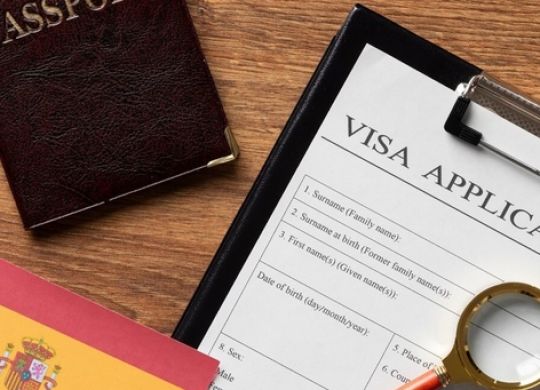
Since August 28, holders of Mauritanian passports must apply for transit visas to travel through Spanish airports. This decision was made to combat the illegal migration of Mauritanians. Learn more about Schengen transit visas
Starting from August 28, 2024, Mauritanian citizens will no longer be able to travel through Spanish airports without a transit visa. This innovation was introduced by the Spanish Government as part of strengthening control over illegal migration from some African countries.
From now on, travelers with a Mauritanian passport will have to obtain a transit visa to transfer to the international zones of Spanish airports. At the same time, these requirements do not apply to those who already have a Schengen visa, residence permit or any other document that allows them to stay in the Schengen area.
In the previous article, we told you that the Spanish region of Extremadura has allocated 2 million euros to attract digital nomads.
Transit visas for citizens of African countries
On August 16, the Spanish government announced new transit visa rules for citizens of several African countries, in particular the Central African Republic. These changes are aimed at preventing illegal migration from Africa and provide for mandatory transit visas for travelers from such countries:
1. Eritrea
2. Ethiopia
3. Ghana
4. Nigeria
5. Democratic Republic of the Congo
6. Somalia
This measure is temporary and can be lifted if the situation with illegal migration improves. However, such innovations have attracted criticism from Spanish immigration organizations, which do not support the introduction of additional restrictions. They note that such measures are often introduced in response to an increase in the number of asylum applications from citizens of countries where conflicts or humanitarian crises occur, which in turn exacerbates the already difficult situation for migrants.

Combating illegal migration at the EU’s external borders
According to the EU border agency Frontex, the number of cases of illegal crossing of the external borders of the European Union, including the Spanish borders, decreased by 40% in the first seven months of 2024. This reduction is due to a number of measures taken by the EU to combat illegal migration, which have contributed to a decrease in the number of illegal border crossings.
The eastern land border and the West African route remain the most active, where the largest flow of migrants is observed. The decrease in activity on other routes is mainly due to the preventive actions of the Tunisian and Libyan authorities aimed at combating people smuggling. Migrants from these two countries account for 95% of all recorded cases on the Central Mediterranean route.
However, the number of border crossings on the eastern land route increased by 195%, reaching 9,546 cases, and on the West African route by 154%, with a total of 21,620 violations. The Central Mediterranean route remains the most active, with 32,239 cases of illegal border crossings recorded in seven months.
For safe relocation and employment in a new country, you will need health insurance. An extended policy can be issued on our websiteby the link.
What documents are needed to apply for a Schengen transit visa?
If you are traveling to a third country through the European Union, you do not need to apply for a visa only if you have planned one transfer within the Schengen area. It is important to make sure that the selected airport has an international transit area that will be available while you wait for your next flight. You can only stay in this area, so unfortunately there will be no opportunity to go out and explore the city. In addition, the connecting time between flights should not exceed 24 hours.
If your trip involves more than one transfer or you plan to travel between the countries of the Schengen area by car, you will need a transit Schengen visa. This visa allows you to travel between several Schengen countries, giving you up to 5 days for transit. It is issued at the consulate of the country through which you enter the Schengen area.
To obtain a transit visa, you must provide proof that your stay in the Schengen area is indeed a transit. These can be flight and hotel bookings, as well as documents confirming your financial viability during your stay in the country.
To apply for a transit visa, you need to prepare the following documents:
1. Visa application form. Fill it out through the e-konsulat system, print it out and sign it.
2. Photography. One 3.5 x 4.5 cm color photo is required. It should be made on a white background, clear and printed on high-quality paper. The photo must have been taken within the last six months. Hats are not allowed.
3. A foreign passport. The passport must be issued no earlier than 10 years ago and be valid for at least three months after the date of the planned return. It must also contain at least two blank pages for visa stamps.
4. A copy of the passport page. You must provide a copy of the passport page with your personal data and photo.
5. Medical insurance. The policy must be valid in all countries of the Schengen area and have coverage for at least 30,000 euros.
6. Proof of residence. Provide a copy of the document confirming your residence in the consular district where you are applying.
7. Confirmation of further travel. This may be an air ticket or a visa to the destination country confirming your trip after leaving the transit zone.
When submitting visa applications for minors, you must additionally provide the following documents:
1. Notarized parental consent. The written consent of one or both parents is required to submit a visa application. If there is only one parent, this should be documented by providing a birth certificate, a court decision establishing exclusive parental rights, or a death certificate of the other parent.
2. Parents’ passports. It is necessary to provide originals and copies of the passports of both parents.
3. Birth certificate. You also need to submit the original and a copy of the child’s birth certificate.
If the child is registered in the passport of one of the parents or an official guardian, it is necessary to submit a separate visa application for the child. The visa will be pasted into the passport of that parent or guardian.
Attention:
– A visa application should be submitted to the diplomatic institution to whose consular district your place of permanent residence belongs.
– These documents are usually sufficient, but the consul may require additional documents.
– The consul can invite a person for an interview, but this is not necessary.
– A type A visa does not allow you to leave the transit area of the airport.
The application fee is 90 euros and is non-refundable, regardless of the decision made. The Consul has 15 calendar days to make a decision, but in some cases this period may be extended to 45 days.
Let’s remind you!Spain has extended the operation of the Law on Democratic Memory, also known as “Ley de Nietos”, which allows descendants of Spaniards expelled during the regime of Francisco Franco to obtain Spanish citizenship. Read more about who is eligible for a passport and what the procedure is.

Igor Usyk – Head of the Legal Department of Visit World
To ensure a safe move to Spain, I advise you to contact a specialist. My colleagues, qualified specialists with legal education, will help you avoid unpleasant situations during migration abroad.
Products from Visit World for a comfortable trip:
Checklist for obtaining a visa and necessary documents in Spain;
Legal advice on immigration to Spain;
Travel insurance for foreigners in Spain;
Medical insurance worldwide.


 English
  Russian
  German
  Polish