A century and a half ago, the Russian Geographical Society (RGS) sent Miklukho-Maklay to New Guinea to study the customs of the Papuans. A lot has changed since then, but the aboriginal tribes still adhere to the old traditions, and the RGS supports research expeditions. An ordinary person can now go on a real ethnographic expedition of the Russian Geographical Society, see both Yamal and Papua at once, get acquainted with the life of Korovai and Nenets!
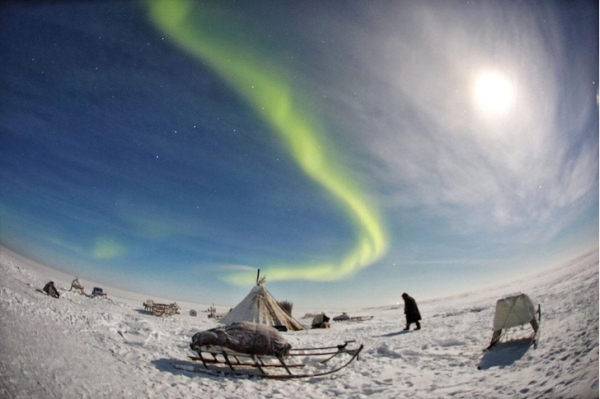
It would seem that what can the Nenets, accustomed to Arctic frosts, and the Papuans lost in the middle of the Pacific Ocean have in common? First of all, the nomadic lifestyle — it is the nomads who will be explored by the participants of the Yamal + Papua expedition. But the reasons for moving from place to place are fundamentally different for these peoples.
The first stop is Yamal
The first part of the expedition takes place in Yamal. The Nenets people living here, who were once called Samoyeds, are famous reindeer herders who have been burning (that is, driving herds) across the tundra for centuries. They do not stay in one place for a long time, otherwise the deer will not have enough food. Like their distant ancestors, the Nenets sometimes dismantle the plague, then put them in a new place — and this is done exclusively by women, and the mobile home itself is often the property of the hostess.
The whole way of life of the Nenets is adjusted to the rhythm of life of the reindeer herd, which feeds, clothes, and helps to transport luggage from place to place.
Children here play with dolls made of bird beaks: duck ones make women, goose ones make men. Another fun for kids is to put on deer antlers and race, imitating traditional sled races. By the way, the races themselves can be seen during the expedition to the Nenets.
The Nenets are a very hospitable people. Researchers who come to them will certainly be treated to stroganina and other national dishes, and will be given original tea. The most important thing is to turn the cup upside down in time, otherwise the owners will constantly pour hot tea into it.
The second stop is Papua
After getting out of the snow of Yamal, the members of the expedition immediately set off for the hot jungles of Papua. The cows living there do not breed herds of domestic animals, but live by hunting and gathering. The tribe builds their houses on tall trees, at an altitude of 20-25 meters above the ground, or even higher. They do this for security reasons — so that representatives of other tribes could not sneak up and steal the women, killing all the men along the way.
The area around the tree on which the house nests is strewn with dry branches, so it will not be possible to approach it silently. The staircase leading to the living room is also tricky — it is designed in such a way that while someone is climbing it, the whole house is shaking.
Such an abode, according to local beliefs, also reliably protects against evil spirits, and wild animals with snakes cannot get inside. Houses are built here without a single nail — there is simply no iron in the local culture, the “Stone Age” literally continues here, and weapons, like tools, are made from improvised materials. Knives, for example, are made from the femur of cassowaries, large tropical birds.
Korovai are forced to roam by the need to get food for themselves. The basis of their diet is the pulp of the sago palm, from which they extract starch to bake bread. Sooner or later, the sago thickets are depleted, and then the tribe moves to a new place. Felled trees are left in the swamp.
After a few months, returning to their former place, it will be possible to get a delicacy from them — larvae of a woodcutter beetle. By the way, the participants of the RGO expedition have a chance to try them — the cows are very attentive to the guests and offer them the most delicious. It is not accepted to refuse in these parts — this is an insult to the owners.
Half a century ago, no one knew about this tribe — the Korowai are quite secretive, and they live deep in the jungle, which is not so easy to reach. It is said that cannibalism was practiced in some clans living in inaccessible places until recently. According to Korovai beliefs, in order to take qualitative revenge on the enemy, you need to eat his brain and stomach, because that’s where the soul is imprisoned.
In order to study the way of life and customs of peoples who have preserved prehistoric traditions, to understand the logic of the actions of nomadic tribes, you need to fully immerse yourself in their lives for some time – this is exactly what the RGS expedition assumes, which sets off in March. During its course, researchers together with the Nenets will repair sleds, engage in ice fishing, will be able to figure out how to make threads from deer veins and how to weave jewelry from beads.
And together with the cows, they will be able to go hunting wild pigs, find out exactly how to fish in swamps, evaluate the effectiveness of bone weapons and the beauty of necklaces made of boar tusks. In the end, it is for the sake of learning new things that expeditions are being started, of which everyone can become a member thanks to the Russian Geographical Society and travel companies cooperating with the society.
Photo: ALEXEY KOLBOV; CHRIS HANNANT, ANDREY GUDKOV / ISTOCK
The material was published in the magazine “Around the World” No. 2, March 2024
The author of the text:Olga Ladygina


 English
  Russian
  German
  Polish