We talked with experts about which promotion channels really work.

The question of where to get paying tourists and how to promote a Russian product is facing many regional businesses. Of course, if you have a popular object in a popular place, then it occurs only in low season. But for most, especially in the last two years, this is a sore point. We talked with experts about how to choose channels for promotion and prepared an overview of ways to solve the problem.
Let’s remember about the sites
Yes, yes, we’ll have to remember the database. Armen Kalajyan marketer and head of the AK Marketing agency, in the current realities, recommends that tourism (and not only) businesses put the site at the forefront. “To some extent, we are now back 10-15 years ago, at a time when social media was not yet so popular,” he says. “The company’s website has come out on top in many Russian markets, which is actually an advertising tool, a promotion tool and a sales tool at the same time.” According to the expert’s experience, those social networks that have remained accessible are not particularly effective for regional companies.
In conditions of a limited budget, when working with the site, Armen suggests focusing on two things — on saturating it with high-quality content and on continuous improvement in terms of usability and conversion rate. Local public sites will help attract visitors from your region. The expert also recommends paying attention to regional bloggers, even if they have small reach — 1000 subscribers will be enough to start with.
For those who are engaged, for example, in excursions, this is certainly a working option, but those who plan to go beyond their region will have to worry a lot about SEO optimization issues.
“Your website should become a SEO magnet to attract traffic from the target regions,” explains Armen Kalajyan, “It should be full of high-quality, detailed information about tours, about the objects that tourists will see, about the company itself. There should be cases, stories of tourists: up-to-date, fresh information that is interesting to read and that will be “loved” by search engines, Yandex in the first place. In fact, once you invest in the site itself and constantly invest in content updates, you will receive targeted traffic without additional advertising.”
Multichannel rules
“There is a systematic reduction in the number of promotion channels in Russia, so now more than ever it is necessary to use multichannel, to maximize all available sources of tourist promotion,” says travel marketer Elena Belousova.
The expert recommends that regional tour operators rely on the site and SEO promotion in search engines, launch contextual advertising, use VKontakte and mailing lists, Telegram and special bots, conduct sales through aggregators and marketplaces. Elena advises paying special attention to the formation of your own customer base and systematic work with it using email, messengers, SMS, retargeting, etc.
For small accommodation facilities The priority is working with maps, collecting reviews and increasing the rating on them, advertising subscriptions on maps, as well as working with hotel aggregators.
If all the listed channels are already involved, and the resources are available, Elena recommends looking towards content marketing – both in text format and video. “It can be a blog in Zen, on its own website, a Youtube channel or any other video platform,” the specialist explains. — This method of promotion is especially important for those companies that are not in the most popular destinations. Popularization of the direction through content is something that can create demand.”
Our dear lead
“Search traffic for travel companies is often not enough if they form groups on a regular basis or count on a serious tourist flow,” Olesya Oleinikova shares her observations,Deputy Director of Profi.Travel, which develops new didgital products of the company. — Yandex Direct, of course, can bring in the missing leads, but their cost is not at all the same as it was before — we see this in the projects of our advertising agency. The probability that small budgets will simply be merged is extremely high, it is no coincidence that everyone is puzzled by the search for new effective tools. At the same time, we see that both large tour operators and very small companies go out to work directly with the client. Time will tell if this is the right decision.”
Elena Belousova notes the same trend: those companies that previously built their sales only through B2B channels began using B2C tools — bank cashback, promo codes. And this is done not only by players at the federal level, striving to diversify sales, but also by completely new, young players who have already started their work in the post-pandemic space.
The high activity of players in the B2C segment further raises the cost of leads. If we also remember about aggregators, which are also focused on independent travelers and have significantly larger budgets than ordinary travel companies, it becomes clear that cheap leads in tourism can only be dreamed of…
Underestimated B2B
…Meanwhile, travel agents are ready to actively sell domestic travel products and note an increase in demand for it. To complete the picture, we decided to share with you some of the research results of the large-scale analytical center Profi.Travel “Russia, domestic tourism: processes, interaction, market trends” in 2024. The research is based on 9 sources, including Profi’s own surveys.Travel, VTSIOM surveys, search query analysis, and others.
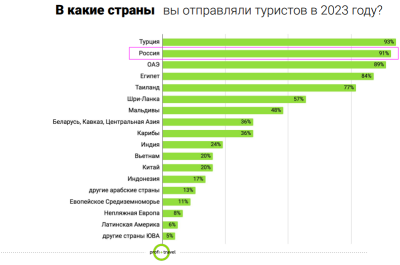
Thus, surveys have shown that Russia ranks second in the list of countries where travel agents sent tourists in 2023.
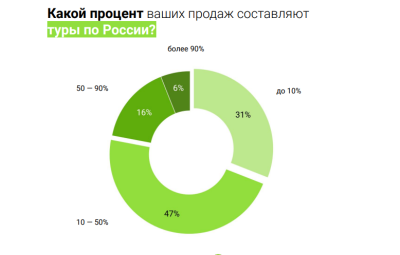
At the same time, most tours in Russia account for less than 50% of total sales, which indicates the significant potential of this channel for the sale of tourist products.
However, the study shows that travel agencies face significant difficulties when working with Russian products. First of all, this is a small selection of regions where there are ready-made tours. This problem is noted by 48% of respondents. Retail is also concerned about the low commission (47%), a small selection of hotels, as well as the scarcity of programs and the inclusion of mostly standard locations in them.
There are no less difficulties when working with regional suppliers. Travel agents note that regional tour operators with non-standard programs are often not ready to work with retail in principle, striving for direct contacts with customers. 32% of the respondents shared this experience. The same percentage notes that the price of tours from local host companies often does not match the level of service offered. At the same time, even in the regions, travel agents cannot always find the right company, implement a non-standard client request, or simply find an interesting program for the right region.
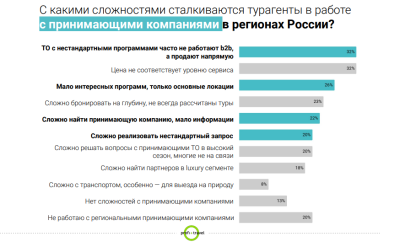
Thus, the situation is somewhat paradoxical: regional companies, especially from “untapped” regions, have a need for new customers, moreover, solvent ones, and travel agents, who have formed a pool of such customers in other directions over the years, cannot always fulfill their requests. Moreover, it is quite obvious that among the regular customers of travel agents there are solvent people who are ready to pay for expertise and trust their agent. That is, the path of a regional tour operator or hotel to such a client through an agent is much shorter. However, at times it seems that B2B channels remain beyond the visibility of both regional ministries and departments developing tourism, as well as regional businesses themselves.
Strategists play for a long time
“For many years now, we have been observing how many segments of domestic tourism are trying to invent a bicycle,” Alexey Vengin shares his thoughts, the CEO of Profi.Travel, meanwhile, there are technologies that have been developed for decades in outbound tourism, as well as a wide retail network that could become the basis for the formation of a controlled tourist flow to different regions, not spontaneous. It would seem that there are proven mechanics, take it and do it… But not as many companies and regions as we would like go to B2B, closing a strategic channel with huge potential. And at the same time, every time after the online exhibition “Know Our”, we receive thanks from our exhibitors, who managed to receive applications from new partners from other regions for complex, unusual programs.”
Elena Belousova sees the reason for this situation in the fact that not all market participants realize that B2B is a long—term game. “There are no b2b sales that can be launched in 3 days and immediately gather a crowd of people who want to cooperate,” she is sure. — B2B is about building long—term relationships. That is, you need to immediately lay down at least a year or two of intensive work with partners so that they feel that they can trust you, they can work with you…And it seems to me that there is a problem here that many companies will try to communicate with agencies for a month or two, they do not get a quick result and give up on this tool. And you need to take part in not one exhibition, but at least ten… And then, conditionally, after a year of intensive work, you will feel the result.”
“Know our” Profi.Travel has been doing this for almost ten years. And some exhibitors participate from year to year. Perhaps this is the most representative online exhibition of Russian travel products. During this time, “Know Our” acquired the power of an independent brand, and an authoritative community with tremendous expertise in the internal product has developed around it. They meet here not only to admire the beauty of the Russian regions, but also to buy and sell — to find partners, to share experiences. Due to the format, the exhibition is available to representatives of all regions of Russia, as well as Russian-speaking specialists of the travel industry abroad. Agents come to Know Our place for a new product, travel product creators come for new distributors, representatives of federal tour operators are looking for host companies in the regions.
“Such a community holds great potential, effectively built relationships between partners can become the basis for long—term well-being and reduce risks when launching complex projects,” Alexey Vengin continues. — Realizing that a number of our partners, who are just starting their work on building such relationships, need support, we decided to help them make the start faster. For the exhibitors of our online exhibition “Know our: Winter 2024/25″, which will be held from October 7 to 27, 2024, we plan to hold a training session on working with the B2B market.”
It is those companies that systematically approach solving problems, and can not only assess short-term benefits, but also calculate long-term prospects, that win in the end. We are sure that such companies will get a chance to become the most prominent players in domestic tourism in Russia.


 English
  Russian
  German
  Polish