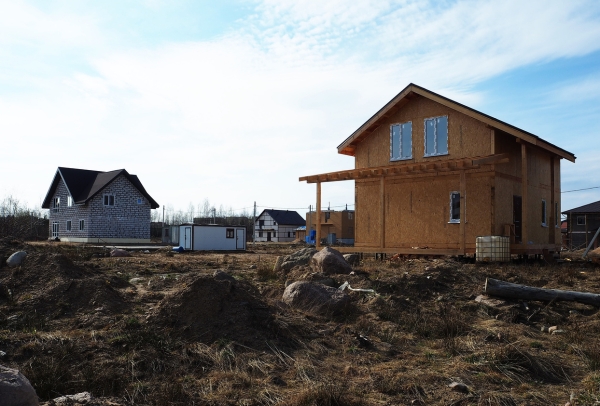
Photo: iStockphoto.com/vilgun
Changes in the mortgage market and innovations in the residential housing market have increased the attention of buyers to individual homes. According to the Federal Register for the Leningrad Region, in 2023, 18.7 thousand residential buildings on residential housing and garden plots were put on cadastral registration, and already in 7 months of this year — 15.4 thousand. Recently, escrow accounts were allowed to be used for the construction of houses and maternity capital was invested in such a mortgage, which also spurred demand. The participants of the Fontanka round table told why both buyers and businesses choose the residential housing market.
Summer season
In the first half of the year, the demand for individual projects in the agglomeration shifted to the region, although some urban areas are also involved in this type of construction. Most of the market is represented by plots.
— Indeed, there are premium-level settlements and a few comfort-class houses for sale, but still, according to the results of the first half of the year, 80-85% of the offer structure are plots without a contract, of varying degrees of preparation, mostly with communications, — says Olga Trosheva, director of the St. Petersburg Real Estate Consulting Center. — The volume of demand for the first half of 2024 has already reached 55% of last year’s for the same period. According to our calculations, this is about 5 thousand transactions, of which over 4 thousand are land plots. Cottages and townhouses make up a small volume in demand – no more than 500 transactions.
Another trend that analysts have noted this year is a 20% decrease in supply. Before that, for several years it was kept at about the same level — about 16 thousand objects in the Leningrad region and urban suburbs. In St. Petersburg Real Estate, they explain this by reducing the withdrawal of new facilities and washing out an attractive offer. As a result, first of all, land prices in popular areas have risen by 15-20%. At the same time, the spread in the average price is very large: if in the south and in the Lomonosov district of the region, weaving costs about 200 thousand rubles, then in the Vsevolozhsky district it is already almost 480 thousand.
If we talk about houses, then one of the most affordable offers — a house under construction — will cost an average of 9 million rubles, although at the end of last year it was 8 million. If we take comfort and high comfort class, the cost increases twofold and reaches 18-19 million rubles. In the business class, this figure is quite stable — about 35 million rubles, and in the elite segment — 80-85 million rubles and above.
— Interest in residential housing is growing in many regions, not only in St. Petersburg and the Leningrad Region — this is the Far East, the Volga region, and Siberia, — said Viktor Zverev, technical project manager at Petro Building Systems. — Moreover, the construction of private houses has ceased to be chaotic, many construction companies are starting complex development of territories, building factories for the production of ready-made house kits. Despite the fact that the market is just being formed, people have already appreciated the quality and speed of the construction of prefab houses. The box with insulation is being built under the roof in record time — from two to seven days. Then there is finishing, furniture — and you can stop by. The preparation and pouring of the foundation goes in parallel with the manufacture of a house kit in production. That is, the consumer, buying a factory-ready house, receives it within two to three months.
In addition, many players in the residential housing market are thinking about the construction of mobile factories on the sites of future cottage development. After its completion, the plant is shut down and moved to another location, starting construction there.
According to the expert, the technology of industrial housing construction, which is used in the construction of apartment buildings, is now actively used in residential housing. Prefabricated reinforced concrete house kits are reliable, energy efficient (A++) and durable (service life from 50 years), while the architecture is quite diverse. Builders are switching to such technology, and someone starts with minimal production facilities with an area of several hundred square meters and produces a house kit in less than a month. With more serious production volumes — one or more house kits per day — it is already possible to comprehensively develop huge territories for cottage settlements with all related infrastructure and social facilities. Moreover, as Viktor Zverev noted, the existing house-building plants, which are now building large residential neighborhoods, consider residential housing as one of the business areas. The marginality of these houses is significantly higher than that of high-rise buildings.
— We are just looking at this market, — said Nikolay Pixaev, General Director of Development-Invest LLC. — Now we are preparing the land that we have and evaluating which product is better to enter the residential housing market in St. Petersburg. We are implementing the project of the Sofiysky Industrial Park, and the idea to turn to the residential housing market came from there. We have a number of resident manufacturers of building materials working for this market, and we see constant demand for their products. This suggests that the residential housing market is now a priority for many buyers. We consider only construction within the city limits, the direction of Pushkin, Kolpino, and evaluate transport accessibility by car so that future residents feel comfortable.
According to Vera Tuchkova, Deputy head of the VTB Retail Sales Department, the bank’s statistics indicate an increase in demand and a great interest of buyers in plots and houses.
— We see a high growth in customer demand for self-construction of houses. In St. Petersburg and the Leningrad region, according to the results of the first half of the year, customers issued mortgages for suburban real estate in the amount of 2.4 billion rubles, of which about 40% were for residential housing. Compared to January — June 2023, the number and volume of such loans showed a significant increase. VTB Bank, as one of the main players in the mortgage market, understands the huge potential of residential housing, — says the expert, — therefore, in early August, a mortgage for the construction of private houses using escrow accounts was launched. It can be issued both under the updated family mortgage program and under the basic conditions of the bank.
Schemes and programs
According to Vera Tuchkova, the bank currently uses three payment schemes for mortgages for residential housing.
— The first is if the project financing of the contractor company and an escrow account are opened in our bank, — Vera Tuchkova said. — The contractor’s accreditation for a mortgage is not required in this case, because when receiving project financing, he has already passed a number of checks. The second scheme of work is applied if the contractor’s project financing is approved by another bank. Then both an escrow and a loan to finance construction can be opened in this bank. In this case, the contractor will be accredited according to a simplified methodology. And the third payment scheme is when the contractor does not need borrowed funds, we only open an escrow account.
According to the basic programs, the bank also changed the terms of lending in terms of increasing the loan amount to 100 million rubles, if the borrower is a salary client and can confirm income through Public Services. If the income is not confirmed through official sources, and the client is not a salary, the maximum amount will be 60 million. At the same time, the bank lifted restrictions on regions and on confirming the initial payment, expanded the possibilities for accreditation, simplified the requirements for land plots, and also introduced loans for the completion of previously begun construction.
— A suburban developer today has all the tools: basic mortgages, albeit with protective rates, different installment options, and so on, — Olga Trosheva added. — For the most part, the companies selling the plots work in installments, and the subsequent construction of the house is carried out with the involvement of a mortgage — but there are few such transactions. If we talk about mortgages for residential housing, then it can be different. For example, the agricultural library in our region is represented minimally. At one time, it supported the market, was modified, but was limited to a clear list of suitable territories. In the overall picture of the suburban market, this type of mortgage accounts for 3% — it’s a drop in the bucket. The family mortgage worked and gave the market what it could. Now the IT mortgage is being activated, which is shifting to the region, since it was canceled for St. Petersburg. But still, this is not a massive tool, as it rests on budget restrictions of 9 million rubles for small settlements. A minimum of 15 million is required for housing and communal services, but if a full-fledged house is being built for living, we are talking about a much higher amount, which means that the mortgage limits should be higher.
Viktor Zverev believes that it is extremely difficult for people who have decided to build a country house to keep everything under control and take construction into their own hands, purchase construction materials, hire crews and constantly monitor the quality of work.
“It’s long, expensive, and very problematic,— he says. — It is easier to come to a specialized company that will make everything “turnkey” or at least a “box” of the future house. Such companies, as a rule, already have extensive experience, have bank accreditations, and participate in mortgage programs. Relatively speaking, customers, instead of buying building materials, purchase ready-made house kits at more attractive mortgage rates than consumer lending.
It’s not enough to buy, we still need to build
A large part of the market and a large share in demand are sites where, after purchase, something else needs to be built. This often drags on for many years.
— It is enough to go outside the ring Road to see how many unfinished houses there are in brick, aerated concrete, and even in monolith, — says Viktor Zverev. — Building a house is about like a renovation: it never ends if you don’t do it right away. Therefore, now we are trying to popularize the rapid construction of buildings, the rapid receipt of the product. When you live in your apartment during construction, it’s one thing, but if you rent and at the same time pay the mortgage for the house, it’s a completely different story. In my opinion, it is the timing of construction, in apartment buildings, in residential housing, that is now the most important factor of choice — everyone wants to get a new home faster.
According to him, there are much more prospects in building cottage settlements entirely, since there is all the necessary infrastructure there. Often, the obstacle to moving out of town is the lack of infrastructure, schools, and the need to take children to the city.
— For several years we have observed a picture when at least half, or even 80% of the supply was just land plots, — says Olga Trosheva. — If the developer has chosen a full—fledged construction strategy, with the architectural concept of the house for implementation, this is one story. But if these are plots without a contract, then, basically, the construction of a house is ordered by contractor companies, and this is not always a quick story. With the involvement of preferential programs, the client actively starts work, since such programs are limited in time. Prefabricated technologies allow you to build an object quickly enough. But given the high cost of the offer and mortgage rates, construction is not going as fast as we would like. There is also a demand for ready—made houses, so construction companies acquire a pool of plots where 5-7 houses are built – and successfully sell them. We also see a number of suburban developers offering an offer at the request of investors or with an invitation to partner with other companies.
— If you are building a house individually, then in any case you must have a ready—made project and a contract, – says Vera Tuchkova. — And now we are faced with a large number of requests specifically for the purchase of houses and plots in cottage settlements. There are conglomerates of developers who build cottage settlements, and we also lend to them. If earlier we did not have the opportunity to issue a loan specifically for the completion of the house, now, even if after the start of construction the client needed additional funds, a loan for completion can be obtained from the bank.
Suburban technologies
According to Viktor Zverev The usual construction technologies in the country market are the assembly of houses from “small pieces”: aerated concrete, brick. This is a rather expensive process, a complex organization of work in terms of the selection of qualified builders. Frame houses also have a number of disadvantages, and the durability of their use has not yet passed the test of time. An alternative method is industrial construction from parts manufactured in the factory. The direction is actively developing, and not only small private companies are interested in it, but also large housing construction plants that build apartment buildings. The main advantages are the speed of construction, high quality, reliability and durability. The technical control department simply will not release a defective part from the factory. At the same time, the price is comparable, and in most cases lower than traditional construction methods. A variety of facade solutions will satisfy almost every taste, and the combination of materials opens up great opportunities for architects and designers.
— Although traditional construction methods still prevail, the market is still shifting towards the industrialization of construction, – says the expert. — Industrial production of house kits in Russia is just being formed, but is already blowing up the market. At a minimum, it outperforms traditional methods in terms of production costs and construction speed. As for the construction of houses from “small pieces”, here the question is not only in building materials, but also in the qualification of personnel, which leaves much to be desired: it is extremely difficult to find a good mason. When everything is under constant control, including the OTC at the factory, it gives peace of mind to the client, who can concentrate on more pleasant things: for example, decide what color the curtains will be.
The expert noted: so far, there is less than 5% of factory housing on the market, but in terms of technology, the market structure is changing. If in the 90s there was a transition to monolithic housing in apartment buildings, now the market is coming back to industrial housing construction – although in a completely different, high quality. The same thing will happen sooner or later in the housing and communal services.
— We are considering partners for the construction of our project from the pool of our residents, — Nikolai Pixaev continued. — We are currently studying all the documentation. According to the format, we decided not to limit ourselves to duplexes or individual residential buildings — we want to go through the whole front: from cottages to duplexes, so that we have an offer with an area from 65 to 150-200 “squares”. Thanks to family mortgages, we primarily see families with children as our clients. Since schools and kindergartens are important to them, we are “pulling up” to existing infrastructure facilities. And according to the construction technology, we will most likely choose aerated concrete.
Financing difficulties
Recently, escrow accounts were allowed to be used in residential housing. According to Olga Trosheva, transitions to new mechanisms are always associated with a number of nuances and difficulties.
Therefore, the residential housing market is now facing the same thing that the urban market underwent in 2019-2020. According to her, it has become more difficult for small companies in the city to obtain project financing due to the differentiated approach of banks. And for large ones — with projects of 100-200 houses — the issue of the cost of this project financing is acute.
— IHS is a market where the buyer wants a specific area: at least 65, at least 120 squares. Therefore, a thorough elaboration of the concept and an assessment of the economics of projects is required here,” the expert says. — For our part, as consultants, we help in assessing market indicators and are faced with the fact that housing and communal services are not so simple in terms of costs. Today, the market capacity and the cost of materials and labor dictates the price that suppliers and contractors can give. It can be said that a successful future from an economic point of view for such projects is associated with a certain mix of individual and low-rise apartment construction, which will pull out the economy and give the infrastructure missing for residential housing projects. I think that some kind of transition and systematization awaits us, the appearance of a register of developers, contractors, and so on. But in a difficult situation with prohibitive mortgage rates, only a few new companies will go out of town, and few customers will be able to buy and build houses.
According to Vera Tuchkova, the market needs time to get used to the introduction of escrow accounts, and banks need to work out how to get such a product in their line.
— In general, we expect an increase in borrowers who will go towards housing and communal services, — says the expert. — As for business, we accept companies for accreditation whose existence period is even less than a year. They need to confirm the experience of construction, and not necessarily of residential buildings, but also of capital construction and municipal facilities. It will be more difficult for a younger company to obtain accreditation, if only for special projects or with superprofits over a short period of existence.
Vera Tuchkova noted that strategically the bank faces the task of expanding its presence in the Leningrad region.
“Priority is given to family loan programs,” she says. — Adaptation is still underway, but closer to autumn we expect an increase in customers with mortgages for residential housing purposes.
— In addition to a noticeable increase in the production of materials for housing and communal services and demand for them, we also see the supply of similar products in our industrial park, — said Nikolai Pixaev. — Taking into account the rapid development of industries focused on the field of housing and communal services, we are looking in this direction. We have made a proposal to residents of our and nearby industrial parks so that their employees can work and live comfortably on the territory of our project. For us, this will speed up construction, and living in individual residential buildings for employees will create significantly more comfort compared to apartments.
— The statistics speak for themselves: it is not the first year that residential housing bypasses apartment buildings in terms of input volume, — Viktor Zverev summed up. — And consumers have been staring at country houses, and they will be staring. I think that if there is support for people’s real purchasing power, they will be happy to move from apartments to houses. The market situation has made the studio the most popular format, but for many it is a temporary solution: there is no money to buy something else. But that doesn’t mean that people don’t want it. Well, from a business point of view now, it will be difficult to enter the market with such rates. And by the time these rates fall — sooner or later it will happen — the business will already be ready and will get the necessary experience.
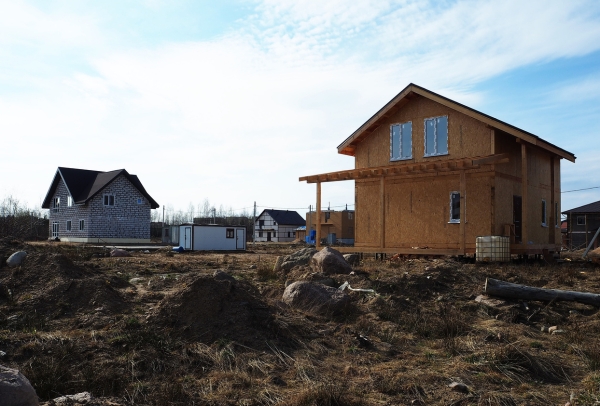
Photo: iStockphoto.com/vilgun
Источник: www.fontanka.ru



 English
  Russian
  German
  Polish