Since time immemorial, exile has been one of the most popular punishments among many peoples. Man is a social being and the deprivation of society of his own kind was perceived by many as a death sentence. The criminal was not only deprived of social support, the opportunity to communicate with relatives, friends and tribesmen, but also found himself face to face with many dangers that had not previously frightened him. This method of punishment, which appeared in ancient times, was adopted by sailors and, despite its apparent humanity, it caused genuine horror.

Already in the Middle Ages, when civilization was sufficiently developed and there were plenty of people on Earth, exile remained relevant only in remote isolated areas. But for the sailors, it still made sense, because they had been to places where it was sometimes more difficult to avoid isolation than in the most extensive desert.

Landing on a desert island or a remote coast from civilization was considered a humane punishment, since a person had some chances to return to society. But, due to the specifics of the sea, such punishment differed little from hanging, drowning or stretching under the keel.
Usually, a person was planted without particularly choosing a place, on the first piece of land that came to hand. It could be a paradise desert island in the Pacific Ocean or a bare rock barely protruding above the icy waves at high tide in the North Atlantic. Therefore, humanity was rather conditional and a lot depended on the captain’s will. The convict could receive a supply of provisions, weapons and gunpowder, but, most often, the exile had a Bible and a pipe with tobacco at his disposal.

The punishment of landing on a deserted island is called maroning, from the word “maron” — a runaway slave. At first, escaped slaves were punished in this way, and later pirates adopted this experience. But this does not mean that the “educational measure” was practiced only by sea robbers — marooning was resorted to without much doubt by military sailors and even captains of civilian ships.
They jokingly said about a man abandoned to his fate on a piece of land — “he became the governor of the island,” but the poor guy himself was not joking at all. For most, such a landing meant a slow and painful death from hunger, cold, thirst, the teeth of predators or the hands of savages. Often a pistol or a musket with a single charge was left on the island so that a desperate loner could commit suicide when his life became completely unbearable.
For a modern person with some knowledge and devoid of prejudice, staying on the island can be painful and dangerous, but not fatal. A couple hundred years ago, things were much worse. We imagine sailors who sailed the seas and oceans in the form of such supermen, desperate, skillful and dexterous, but such people were rare in the navy. Surprisingly, most of the sailors did not know how to swim and had only the knowledge necessary to perform duties on board.

Among the sailors, illiterate people prevailed, many of whom were recruited or tricked on board by port recruiters. Such a “sea wolf” had no more chances of survival on the island, far from taverns, shops and other benefits than a modern resident of a large city who grew up “on the balcony”.
However, there are many stories about a successful outcome for those left on uninhabited islands. The most famous “governor of the island” in history was Alexander Selkirk, immortalized by the English novelist of the 18th century Daniel Defoe in the image of Robinson Crusoe. Selkirk was not a criminal — the captain of the ship “Sankor”, Lieutenant Stralding, got rid of him because of his obnoxious nature.
Boatswain Selkirk bothered everyone with his constant lamentations about the poor condition of the ship, which, in the opinion of many, could cause trouble. According to some reports, Aleksand himself hastily demanded to be put ashore during one of the conflicts. The captain did not try to persuade the boatswain to come to his senses and the grumbler was landed on the deserted island of Mas a Tierra, located 700 km west of the coast of Chile.
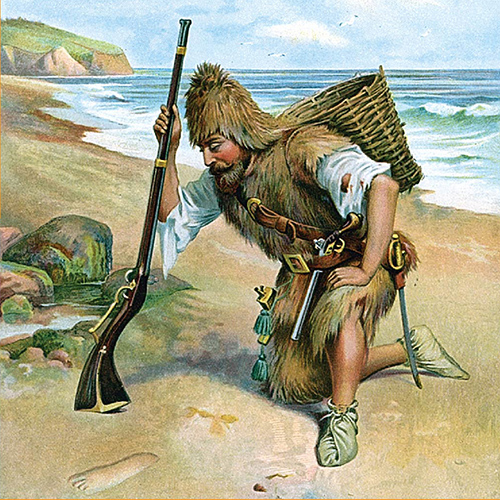
The sailor spent 4 years in complete isolation from society and was rescued by the ships of the privateer expedition of Captain Woods Rogers, who was hunting for Spanish ships. It is worth adding that Selkirk was not so wrong when he grumbled from morning to night and pointed out the shortcomings of his ship. Very soon, the ship “Sankor” sank along with the entire crew during a fairly modest storm. So the punishment for boatswain Selkirk turned into salvation, and the world received a wonderful novel about the power of the human spirit.
There are cases when a captain who was fed up with the team was landed on the island. This is what happened to the famous pirate Edward England. He, along with two assistants, were landed by pirates on an island in the Indian Ocean. England and his colleagues not only did not disappear, but they were able to save themselves.
Three pirates made a raft from improvised materials and got to Madagascar on it. England himself died in poverty and oblivion, but in old age and in his own modest bed. But the team that rebelled against him was caught and hung on the yards.
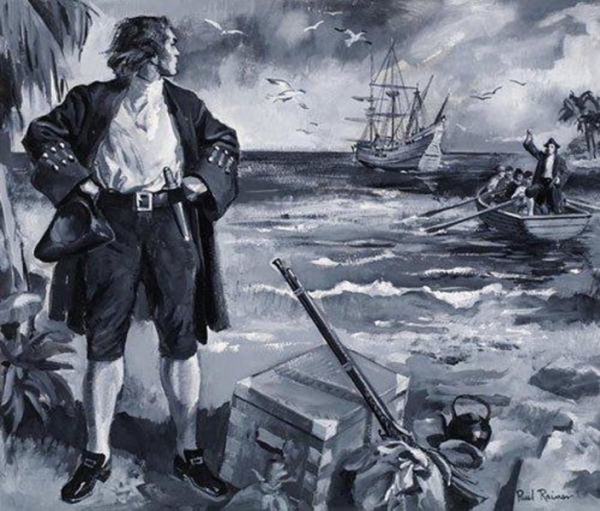
Sometimes fans of maroning were punished by law. This happened to Captain Warwick Lake of the British Royal Navy, who landed one of his guilty sailors named Robert Jeffrey on a desert island in the Caribbean Sea. The punished man did not suffer from loneliness for long — he was soon rescued by American merchants sailing by.
Jeffrey decided not to leave the case like that and upon his return to Britain, he filed a lawsuit against the former commander in a naval court. Admiralty officials reviewed the case and issued a sensational verdict — to recognize the rootless sailor as a victim, and to dismiss Captain Lake in disgrace from The Royal Navy for inhumanity and arbitrariness. But this story is rather an exception to the rule, since the captain was almost always right and could control the fate of the team members at his discretion.
There were also women among those subjected to maroning. The most tragic story can be considered the story of Marguerite de la Rock is a French noblewoman who lived in the 16th century. This lady was more unlucky than many sailors — she was landed on the island of Demons off the coast of the harsh island of Newfoundland, in the North Atlantic.
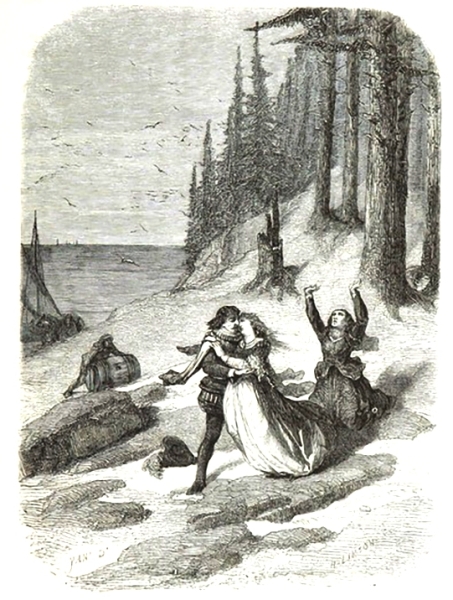
The landing of Marguerite and her companions on the island of the Demon
Marguerite became a victim of her relative de Roberval, with whom she traveled from France to the colonies. De Roberval, appointed ruler of New France and en route to his new possessions, accused the woman of a vicious love affair with one of the passengers of the ship. Many believe that the real reason for Marguerite’s landing on the island was the banal greed and meanness of a noble relative. He had a lot of debts and wanted to take over the woman’s property.
With Marguerite de la Her lover and maid were landed on a wild northern island. But fate willed this woman to drink the cup of trials in full — her companions soon died of diseases, and soon after that the child born to a woman on the island died. The French noblewoman herself survived, which can only be called a miracle. The lady had to learn a lot of tricks, starting from hunting an animal, and ending with making fire.
It is not known exactly how much time Marguerite spent on the island of Demons — her biography modestly states that the misadventures lasted “several years”. A strong-minded woman was rescued by Basque whalers and returned to France, where she became famous thanks to the Queen of Navarre. Gifted with literary talent, the royal person described the adventures of de la Rock in his book “Heptameron”.

Now the island of Demons is called the Hospital and is part of the group of islands de la Demoiselle, which were so named in honor of Marguerite. Nowadays, on a wooded island that is not rich in sights, tourists are shown a cave where, according to unverified data, this strong woman spent her days waiting for help.
There was a Robinson Crusoe in The Russian Empire is the Hussar cornet Sergei Lisitsyn, whose amazing story deserves a separate story.


 English
  Russian
  German
  Polish